Data & Analytics
Data Engineering & Data Warehousing
We build data pipelines and data warehouses on BigQuery, Snowflake and PostgreSQL that collect data from your business systems, clean it and make it reliable for reporting, analytics and AI.
What is data engineering?
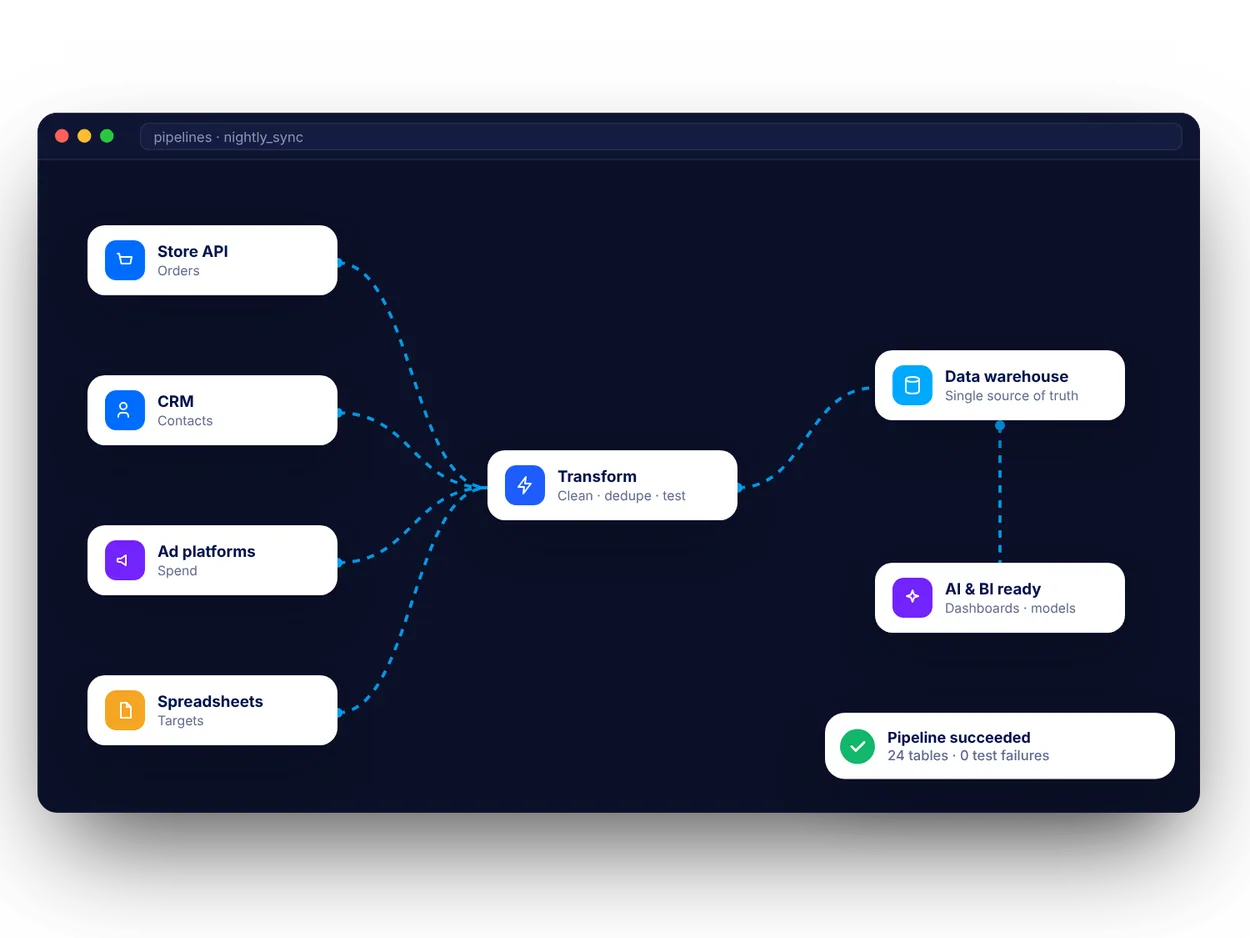
Data engineering is the work of moving data from the systems where it is created, such as your CRM, store, ad platforms and accounting software, into one place where it can be trusted and analysed. It covers pipelines, transformations, data quality checks and the warehouse that stores the results.
What does our data engineering service include?
- Data pipelines and ETL/ELT: automated extraction from SaaS tools, databases and APIs using open-source or managed connector tools, plus custom connectors where needed.
- Data warehouses: BigQuery, Snowflake or PostgreSQL, sized for your data volumes and budget.
- Transformations: clean, documented data models built with SQL-based transformation tools such as dbt.
- Data quality: tests for missing, duplicate or unexpected values, with alerts when something breaks.
- Orchestration and monitoring: scheduled runs, logging and failure alerts.
- AI-ready data: structured, well-described data and document stores that AI assistants and models can use safely.
Do small businesses need a data warehouse?
Not always. If your reporting comes from one or two tools, a dashboard connected directly to them may be enough. A warehouse becomes worthwhile when data is spread across many systems, reports disagree, spreadsheets are doing too much work, or you want to use your data for AI projects.
How does the process work?
- Assess: list data sources, volumes, owners and the questions the business needs answered.
- Design: choose the warehouse, connector approach and data model.
- Build: pipelines, transformations and quality tests, starting with the most valuable sources.
- Connect: link BI tools, applications or AI services to the warehouse.
- Operate: monitor runs, control costs and add sources over time.
Why choose Digitexa AI for data engineering?
- Right-sized architecture for small and mid-sized businesses, without enterprise overhead.
- Widely used, well-documented tools, so your data stack is not tied to one supplier.
- A direct path to useful BI dashboards on top of reliable data.
- Attention to access control and privacy for customer and financial data.
Ready to talk? Tell us about your project and a senior engineer will reply with next steps, questions and a suggested approach.
Data Engineering & Data Warehousing: FAQs
What is the difference between ETL and ELT?
ETL (extract, transform, load) cleans and reshapes data before loading it into a warehouse. ELT (extract, load, transform) loads raw data first and transforms it inside the warehouse, which is the common approach with modern cloud warehouses such as BigQuery and Snowflake.
Should we use BigQuery, Snowflake or PostgreSQL?
BigQuery is a natural fit if you use Google Cloud, GA4 or Google Ads. Snowflake works well across clouds and for larger teams, and PostgreSQL can be a cost-effective choice for smaller data volumes; we recommend based on your data, tools and budget.
What does it mean to make data AI-ready?
AI-ready data is accurate, consistently structured, well described and governed by clear access rules. That allows AI assistants and models to use it safely, for example to answer questions about sales or customers without exposing sensitive information.
How long does it take to set up a data warehouse?
A first version connecting a few key sources can often be in place within a few weeks. The full timeline depends on the number of sources, data quality and how much transformation is needed.